Connections trapped on one laptop
Every teammate re-enters the same hosts, ports, and databases by hand. Onboarding a new dev means a Slack thread of screenshots.
Local-first database client
The database client your whole team can commit to git.
Version-controlled connections and queries. Native Rust and GPUI. Postgres, SQLite, and MongoDB — no accounts, no backend.
v2026.8.1
Database clients treat connections and queries as private, machine-local state. So teams keep re-sharing the same things by hand.
Every teammate re-enters the same hosts, ports, and databases by hand. Onboarding a new dev means a Slack thread of screenshots.
Passwords live inside a GUI's private config, never reviewed, never rotated together, impossible to audit.
The useful report you wrote last week is stuck in your client's history. Nobody else can find it, run it, or improve it.
based puts all of it in a .based/ folder you commit to git — and keeps the secrets out.
based reads a .based/ directory in your repo. Connections and saved queries are small TOML files your team reviews in pull requests. Secrets go in a gitignored .env — never committed. Read the docs.
schema_version = 1

name = "based"
description = "A new Based project"

[settings]
query_timeout = 30_000 # ms
max_result_rows = 1_000
enable_query_cache = true
cache_ttl = 3_600 # seconds
schema_version = 1
name = "Churn by Geography"
description = "Customer exit rate by country"
tags = ["churn", "reports"]
[target]
# ↓ refers to connections/local.toml
connection = "local/postgres"
[sql]
query = """
SELECT
Geography,
COUNT(*) AS customers,
SUM(CASE WHEN Exited = 1 THEN 1 ELSE 0 END) AS exited
FROM demo.customer_churn
GROUP BY Geography
ORDER BY customers DESC;
"""schema_version = 1
label = "Local PostgreSQL (Docker)"
engine = "postgres"
tags = ["local", "dev"]
host = "localhost"
port = 5432
database = "based"
username = "based"
password = { env = "LOCAL_PG_PASSWORD" } # ← secret lives in .env
ssl = false# Copy to .env and fill in real values.
# This file is committed — .env is gitignored.
# Referenced by connections/local.toml
LOCAL_PG_PASSWORD=supersecret
# Referenced by connections/mongo.toml
MONGO_URL=mongodb://localhost:27017Postgres-first depth for the things you actually touch every day — connect, explore, query, edit, and reuse.
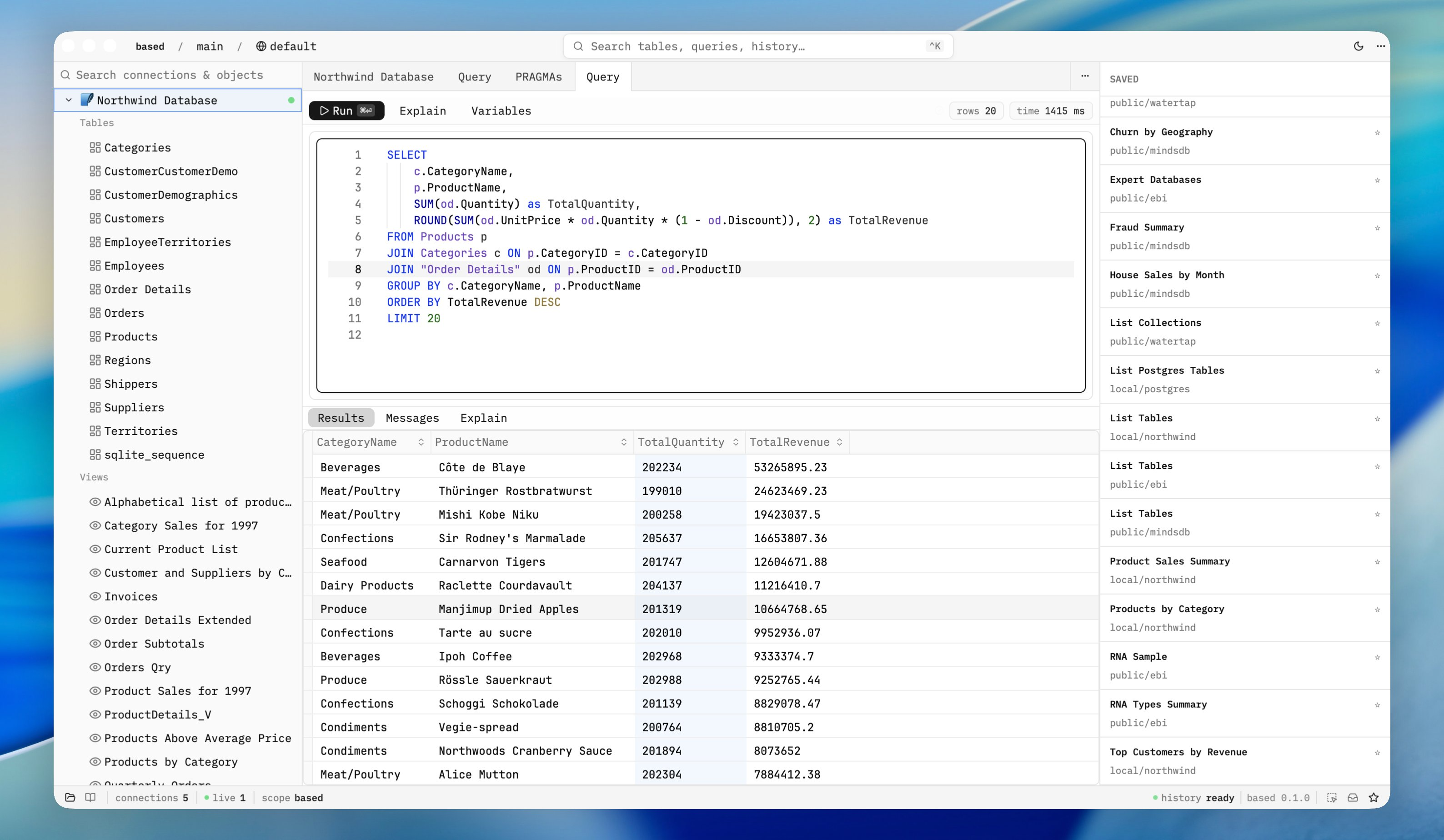
Multi-tab editor with syntax highlighting, one-key formatting, and autocomplete. Run the selection, the current statement, or the whole script — and cancel long runs.
Parameterize queries with user variables and built-in {{$…}} injection, so the same query works across environments without edits.
Browse schemas, tables, views, indexes, and functions in a responsive tree. Search across objects and open data or DDL instantly.
Inline-edit rows with an explicit dirty state and save/discard. No silent commits — writes never happen behind your back.
Every run is saved to a searchable local history. Pin the queries you reach for and rerun a past one in seconds.
Drive everything from the keyboard — new query, connect, refresh, format, run, history — without hunting through menus.
Postgres, SQLite, and MongoDB connections live side by side in the same .based/ folder — pick the engine per connection file.

The primary engine. Schemas, SSL modes, test-before-connect, and deep daily-driver parity for local, staging, and prod.

File-backed databases with connection-time PRAGMA control — journal mode, synchronous, and foreign keys, right in the connection file.

Collections and aggregations alongside your SQL connections, in the same version-controlled project.
based is a native desktop app that keeps you in control of your data and your setup — by design.
There's no service to sign up for. based runs entirely on your machine — nothing to provision, nothing to trust.
Connections go straight from the app to your database. No proxy, no telemetry pipeline, no cloud in the middle.
Built on the same GPU-accelerated UI framework as Zed. It launches fast and stays responsive on large schemas and result sets.
The whole client is MIT-licensed and developed in the open. Read it, fork it, ship it.
Grab the latest stable release for your platform. Free and open source — no sign-up required.
Apple Silicon
fa722158…9562f062 brew tap pavi2410/tap && brew install --cask based x86-64
45718494…fef25bd3 91930754…5d5e8ff8 x86-64 · Windows 10 & 11
507d159e…cc89fffd winget install pavi2410.Based based is free and MIT-licensed. Sponsorship funds time for features, fixes, and releases across macOS, Windows, and Linux.
No. based has no backend and no telemetry. The app connects directly from your machine to your databases — nothing is routed through a server in between.
Connection files store hosts and non-secret config only. Passwords and connection URLs reference environment variables (for example { env = "LOCAL_PG_PASSWORD" }), and the actual values live in a gitignored .env. A committed .env.example documents which vars teammates need.
No accounts, no sign-up, no license keys. Download it and connect.
based is free and open source under the MIT license — no license keys or subscriptions. If it saves you time, you can sponsor development on GitHub to help fund ongoing work.
macOS (Apple Silicon), Windows, and Linux (.deb and .AppImage).